AI experience in customer service
For customers, it doesn’t matter which model is running in the background. What matters is the outcome: Am I being understood? Is my enquiry actually being dealt with? And will I still get help if the agent reaches the limits of what they can do?
That’s why it’s not the most intelligent model that wins, but the most reliable system as a whole.
What do we mean by ‘AI Experience’?
By ‘AI Experience’, we do not simply mean interaction with an AI agent. It arises from the interplay between design, data integration and the processes that govern and control the system’s behaviour.
The AI Experience thus extends from the customer’s first sentence right through to the action taken in the backend – and, where necessary, to the handover to a service representative.
The customer experiences the dialogue. Behind the scenes, the company must master a controlled service process.
Four tasks are crucial for this: understanding, guiding, acting and ensuring.
Understanding: Not recognising words, but categorising concerns
A good AI agent must recognise what the customer is actually concerned about.
This involves more than just speech-to-text conversion or recognising individual terms. Customers often phrase things incompletely, correct themselves, interrupt or deviate from the expected sequence of events. It is precisely under these realistic conditions that the agent must understand the context.
Quality is therefore demonstrated not in a perfect test sentence, but in a real conversation.
Guidance: Speaking naturally is not the same as providing good guidance
Large Language Models can formulate polite and linguistically correct responses. However, this does not automatically result in good conversation management.
If the issue is still unclear, an open-ended question can be useful:
“Could you briefly describe what this is about?”
If the context is already known, a targeted question is often more helpful:
‘Would you like to reschedule your existing appointment or cancel it altogether?’
Both approaches can be correct. The key is to offer the right balance of openness and guidance at the right moment.
This makes conversational design more than just a question of word choice. Voice, tone, conversational rhythm, pauses, interruptions and transparency also shape the AI experience.
The model generates language. Design gives it direction.
Taking action: A response must lead to a service task
In customer service, it is not enough simply to give the right answer.
A customer doesn’t just want to know how a contract amendment works; they want it to be carried out. This is precisely where a linguistically convincing AI agent differs from a genuinely useful service agent.
To achieve this, the AI agent must be able to access relevant information in a controlled manner and trigger defined actions – such as checking, amending, scheduling, documenting or initiating a follow-up process.
The key here is not to provide the model with as much information as possible.
A good AI experience requires not maximum, but relevant context.
The agent should receive precisely the information necessary for the current step in the process – from a defined source, up to date and with controlled access rights.
This enhances traceability and control whilst avoiding unnecessary data movement and costs.
A good AI experience is therefore not created by allowing an agent to act as freely as possible. It is created by ensuring that, at the right moment, the agent receives precisely the freedom, context and capabilities required for the next service step.
Safeguarding: Good automation knows its limits
A good AI agent does not have to resolve every case itself.
On the contrary: good automation recognises when confirmation is needed, when an action should not be carried out autonomously, and when it makes sense to hand the matter over to a human.
The quality of this handover is then crucial.
A poor handover forces the customer to identify themselves again and explain their enquiry once more. The context established previously is lost.
A good handover, on the other hand, conveys:
- the identified issue,
- the relevant customer and case context,
- checks already carried out,
- the outstanding question and
- the next logical step.
The service representative does not start from scratch, but continues the process.
The channel may change. The customer experience must not be interrupted.
A handover is therefore not a failure of automation. It is part of a resilient service architecture.
The reality check before going live
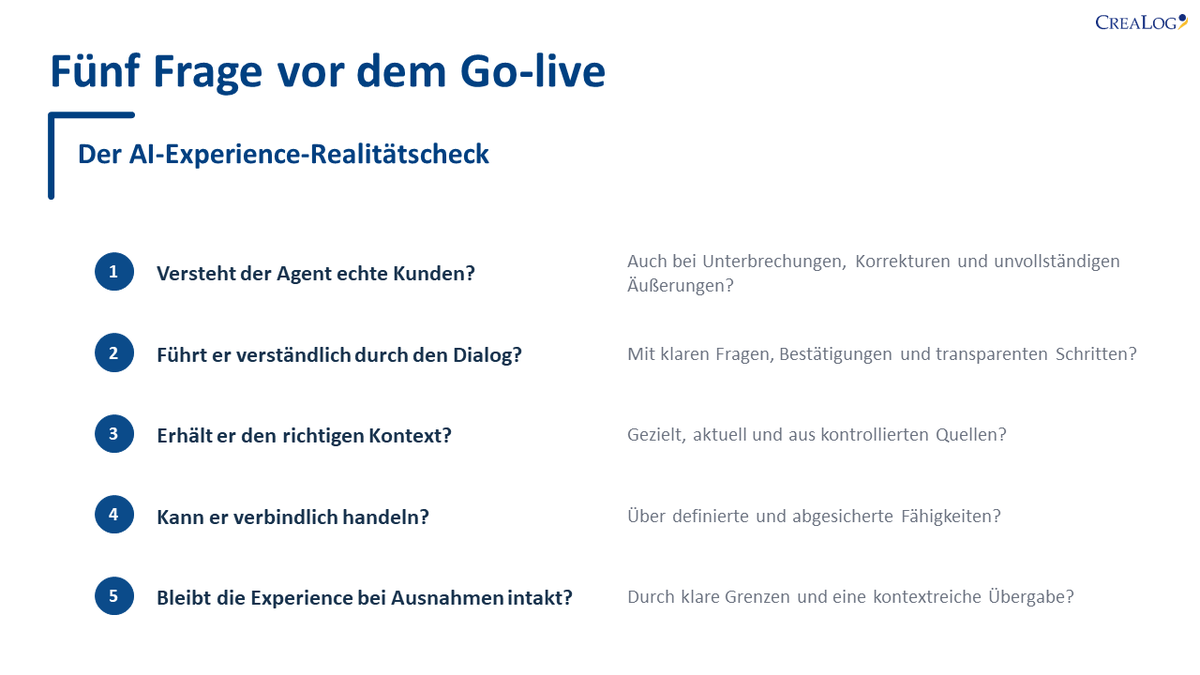
Before deploying an AI agent in a live environment, companies should be able to answer five questions:
Does the agent understand real customers?
Even when there are interruptions, corrections or incomplete statements?
Does it guide the user through the dialogue in a clear manner?
Are the questions unambiguous and are the next steps clear?
Does it obtain the correct context?
Is it targeted, up-to-date and sourced from verified sources?
Can it take binding action?
Are there defined and validated capabilities that allow a response to be turned into a service transaction?
Does the customer experience remain intact in exceptional cases?
Are there clear boundaries and a context-rich handover?
If any of these questions is still answered with ‘We’ll sort that out later’, this does not necessarily rule out AI agents. However, it may be a sign that the use case should initially be narrowed down.
Conclusion
AI experience does not end with the dialogue. It arises from the interplay of design, data integration and the processes that govern and control the system’s behaviour.
This is precisely where the quality of an AI agent in customer service lies: it must understand customers, guide them effectively, act within the correct context and know its limits. Only then does it become clear how reliably the entire experience functions – from the very first sentence right through to the outcome of the service process.
The LLM provides the language capabilities. A good AI experience is only created through the interplay of design, data, processes and control.