CreaLog Summit 2024
)
Bots and AI for customer communication
This year's CreaLog Summit focused on the customer experience, looking closely at the opportunities that integrating artificial intelligence brings to this process. Through talks and workshops, practical strategies balancing competitiveness and customer satisfaction were discussed and openly debated, enabling AI's potential to be fully leveraged and agents to be relieved of routine tasks. The closing panel discussion on changing customer communication behavior and its impact on CX design was especially engaging.
Two successful days on the future of communication
Over two days, we had the opportunity to explore these topics in depth. High above the rooftops of Munich, Day 1 opened with two keynotes by Stefanie Kolling (T-Digital) and Sophie Hundertmark (Hundertmark) on the AI-driven future of customer experience, followed by three CreaLog presentations on IN, bots, and API, as well as on AI using proprietary data and bots in Microsoft Teams.
Dirk Hutmacher (CreaLog) highlighted the value created for telcos and enterprises. The CreaLog Service Delivery Platform is the foundational omnichannel platform for enterprise and telco customers. A positive customer experience remains the priority even beyond system and platform migrations. The CreaLog Service Manager provides access to the platform, allowing applications to be administered and processes controlled independently, all within a single platform. What matters here are standards that make it possible to configure adjustments and processes, so that individual, changing requirements can be met.
In his talk, Dr. Bernd Plannerer (CreaLog) explained how companies can build AI using their own data. One approach is based on conversational AI: spoken input is used to identify the intent and entity behind an utterance, triggering matching, pre-trained responses. This requires a large number of stored variations of customer phrasing so that sufficient training material exists for CLU. These sentences and questions serve as example utterances, and ChatGPT can help generate this variety, removing the need for tedious manual drafting. When using generative AI, responses are not pre-trained but generated in association with the input. Here, the generative AI's world knowledge is combined with a company's own data, which must be prepared and integrated accordingly. The responses it produces are generated and then enriched with the integrated company data.
Next was Michael Kloos (CreaLog) on applications in Microsoft Teams. Teams has since become a central communication channel, especially as a customer-facing application for network operators. It can be integrated via the CreaLog platform, or custom voice or chat bots can be made available as apps within Teams. The talk presented three use cases: policy-based recording via Teams in the Azure Cloud, meaning voice recordings for example for banks, healthcare, or legal services via network operators. Teams chatbots offer a simple entry point for AI within a company and can be made available to employees across various application levels. Voice bots can also be integrated into Teams as part of a multi-channel platform managed through the CreaLog Low Code Service Creation Environment, enabling voice chat over Teams just as with regular telephony.
Day 2 featured intensive work across three parallel workshops. Anne Schilling offered insights into the importance of good voice UX design. In Michael Kloos's session, a low-code bot was built in five key steps, while Anna Mutska's workshop explored the right prompting for successful communication with ChatGPT.
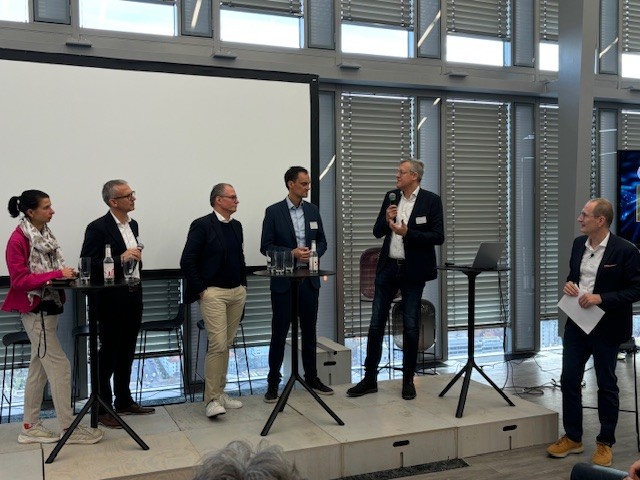
The closing panel, with its strong lineup of speakers, discussed the shift in customer communication behavior, the importance of well-coordinated internal processes for providing data in response to customer inquiries, and the relevance of multichannel interaction options between customers and companies. The corresponding platforms for multichannel interaction already exist from a technical standpoint. What matters most is customer-oriented design and successful implementation. Developments are moving fast, and today we have capabilities we couldn't have imagined two years ago. "Where will we be in 5 years?" was the big question put to the panel at the end of the discussion, one that invited free-ranging speculation.
Why AI in CX?
AI's potential in CX lies in personalizing the user experience for each individual customer and making the underlying processes more efficient, helping customers quickly resolve their concerns and turning inquiries into experiences. Innovative, efficient, customer-oriented services that stand out from competitors through the targeted use of AI give companies a competitive edge. Customer service is the area where AI can unfold its potential most, since it involves high volumes of communication and routine tasks that bots and AI can automate, freeing up human employees to focus on tasks that create greater value. The guiding principle for AI deployment coined by Sophie Hundertmark at our summit, "as much human as necessary, as much machine as possible," captures this interplay between AI and employees, one that regular optimization keeps in balance between automation, efficiency gains, and personal interaction.
How can implementation succeed?
Technological advances that improve the customer experience and drive continuous improvement help customers accept these technologies. Customers need to be able to get used to new technologies step by step and recognize the benefits they bring. The strategy for successful implementation is based on a step-by-step approach, starting with identifying suitable AI use cases to keep the roadmap achievable and realistic. The challenge with many AI projects is their high complexity, which can be overcome through targeted prioritization, turning AI projects into success stories. In this new environment between humans and machines, it is essential to adapt the IT system architecture through flexible platforms and to embrace omnichannel and multichannel platforms with a future-oriented approach. Customers must be able to use the channel of their choice to start the conversation. This lifts the customer experience to a new level, with service experiences appearing consistent everywhere.
What else is needed besides customers and technology?
Naturally, employees themselves must be trained in data-driven ways of working and receive further training alongside the introduction of the new technology as part of change management. Customers aren't the only ones who need to accept innovations and be gradually introduced to them; competent data handling and acceptance of what's new must also be established within the organization itself.