An AI agent is not only successful in the telecoms sector simply because it sounds natural or provides a linguistically correct response to a query. It is successful if it can operate reliably within a highly complex, mature system landscape.
This is precisely what sets telco automation apart from many isolated AI applications. A carrier service does not run in a self-contained front-end. It operates within an architecture in which IMS networks, signalling, media servers, messaging systems, BSS/OSS, CRM, billing, provisioning and customer data must all work together seamlessly. At the same time, there are requirements that are non-negotiable in the telecommunications environment: the service must be multi-tenant, geo-redundant, highly available, auditable, secure, scalable, resilient to load and subject to regulatory oversight.
The key question is whether an AI agent can be integrated into operational carrier processes in a controlled, traceable and stable manner.
Carriers do not operate simple, standalone applications. They operate service landscapes that have grown over years or decades. Legacy IN, number translation services, Voice VPN, IVR, contact centres, recording, messaging, NG112 and customer care are not isolated functional modules. They are interlinked, utilise shared network resources and must be further developed whilst the network is in operation.
A modern service delivery platform provides the technical foundation for this. It thus serves as a versatile basis for various components: signalling, routing, media, messaging, AI solutions, backend integration and service creation within an architecture that supports both existing networks and new cloud-native environments – for standard and customised applications.
New services do not need to be integrated from scratch every time. Instead, they can be built on a platform that continues to utilise existing network logic whilst simultaneously delivering new services more quickly.
For carriers, the business opportunity arises where platforms transform network functions into marketable services. Connectivity remains the foundation. However, growth is increasingly driven by services that carriers can offer directly to their customers.
These services require carriers to combine their network expertise with service expertise. It is not just a matter of providing a service from a technical perspective. What is crucial is being able to operate it as a B2B offering that is multi-tenant, scalable, manageable and billable.
Platform expertise is a competitive advantage. It enables carriers to develop their existing infrastructure cost-effectively and to generate new value in addition to simply providing network services.
Agentic AI is redefining the expectations placed on automation. Traditional bots answer questions or guide users through predefined dialogues. Agentic AI can pursue objectives, identify missing information, plan intermediate steps and orchestrate workflows.
An autonomous AI agent should do more than simply provide information. It should, for example, verify customer data, amend routing rules, activate service options, create tickets, generate conversation summaries or trigger backend processes. This must not happen without supervision. The AI agent requires access to data, tools and workflows. This access must be authorised, restricted, logged and auditable. Otherwise, it poses a risk to operational security, data protection, compliance and service quality.
How can backend and data access by AI agents be implemented in a way that ensures data sovereignty and is properly controlled?
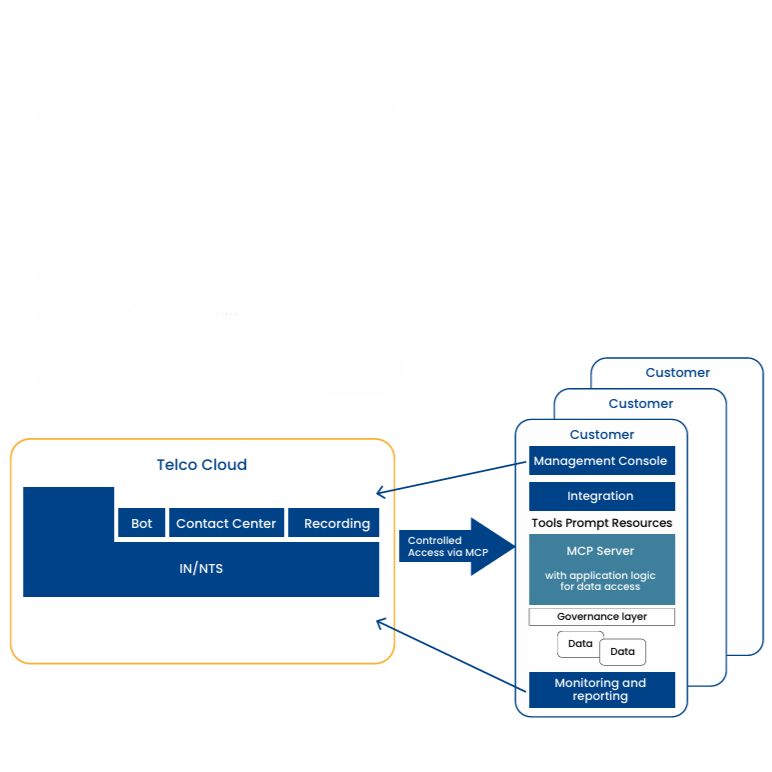
For AI agents, the CreaLog SDP provides the necessary control and integration layer between AI and the backend. It provides the architecture through which AI components can securely access data, tools and workflows without directly or uncontrollably interacting with operational systems.
Integration mechanisms such as the Model Context Protocol (MCP) are key building blocks within the platform architecture. They help to separate AI-based reasoning from backend execution. The AI agent therefore does not have free rein to access any system at will. It can only utilise defined, authorised capabilities provided by the platform via controlled interfaces. In this way, the platform architecture empowers AI agents to act without relinquishing access control. They are used to manage policies, rights, roles, logging and execution logic. MCP servers can provide authorised functions, data access and workflows; the MCP client mediates server access in a controlled and integrated manner, within the platform’s governance and operational logic.
This is how innovation and operational reliability come together: AI can understand customer concerns, conduct convincing dialogues, prepare decisions and orchestrate processes. However, actual access to backend systems does not take place directly via the LLM, but is controlled via the platform. At the same time, this architecture lays the foundation for connecting business customers’ systems and data to telco services and systems whilst maintaining data sovereignty. This enables carriers not only to automate their own processes, but also to provide secure, controlled AI-based services in a multi-tenant configuration for their B2B customers.
Many carriers face the challenge of integrating new AI and cloud capabilities with existing IN, TDM, NGN, IMS and BSS/OSS landscapes. These legacy environments are not simply dead weight. They contain business-critical logic, customer data, routing rules and established service processes.
A strong platform strategy does not abruptly replace these investments. It integrates and modernises them. This enables carriers to continue operating existing services, migrate them and, at the same time, roll out new AI-based services.
This is particularly important because telco transformation rarely takes place on a greenfield site. New services must be developed whilst operations continue. Platform expertise therefore also means migration expertise: services are modernised step by step, without compromising stability and availability.
In the carrier environment, it is not the demo that determines the success of an AI agent. What matters is live operation.
What counts is whether the service runs stably.
What counts is whether customers reach their destination faster.
What counts is whether business customers receive new services.
What matters is whether existing network investments can continue to be utilised.
And what matters is whether AI is controlled, integrated and operated at a telco-grade level.
AI agents become relevant for carriers when they are not viewed as isolated applications, but as an integral part of a platform architecture. Only when network logic, business processes, backend access and AI orchestration are brought together does genuine business value emerge.
Carriers that currently operate a robust service delivery platform have a strategic foundation for the next stage of telecoms development. Not only can they operate existing services more efficiently, but they can also offer new B2B services, customer care automation and controlled AI agent scenarios.
Agentic AI derives its value not from maximum autonomy, but from controlled decision-making capability. This is precisely why a telco-grade platform is required: integrated, highly available, auditable, multi-tenant and capable of interfacing with established network and backend environments.
For carriers, the value of AI agents lies not in dialogue alone, but in the secure integration of AI orchestration, network logic and secure service execution. Those who master this platform capability can turn connectivity into scalable, intelligent and trustworthy services.