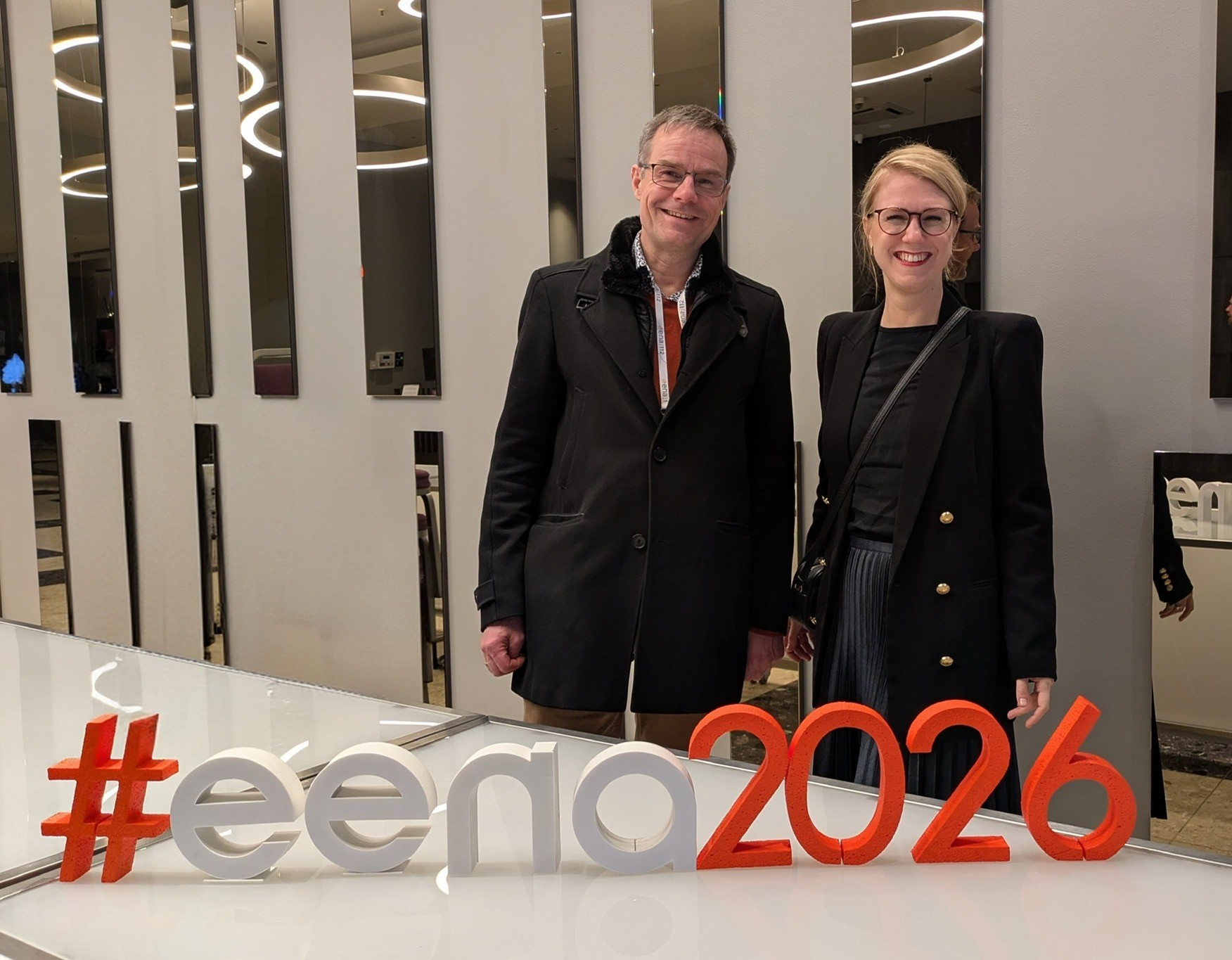
From 15 to 17 April, the EENA Conference 2026 brought together experts from across Europe and beyond in Riga to discuss current developments around the 112 emergency number, identify challenges and exchange best practices.
It quickly became clear that the discussion was not about abstract technology debates. The real question is how emergency communications can remain reliable under changing technical and geopolitical conditions. This perspective was also reflected in the conference programme, which highlighted the humanitarian dimension of emergency communications and rescue operations in a particularly powerful way.
A special tribute was paid to Demetrios Pyrros, founder of EENA and co-founder of Doctors Without Borders in Greece, who received the Special 112 Award for his achievements. Leonid Tymtschenko from the Ukrainian Ministry of the Interior also spoke about the operational reality of emergency communications and crisis response under extreme conditions.
Europe’s emergency communications ecosystem is moving in the right direction both strategically and technologically. At the same time, the transition phase is increasing fragility. This is especially true where new standards and services have to be integrated into existing network and PSAP environments.
Topics such as Direct-to-Device connectivity via satellite, post-2G/3G emergency calling, enhanced caller location, transitional NG112 solutions and resilience in crisis scenarios all showed that the target architecture is becoming clearer. The critical question, however, is whether it will perform reliably in live operations.
One of the most closely watched topics in Riga was the development of Direct-to-Device connectivity for emergency calls via satellite. The direction is clear: where terrestrial mobile networks are unavailable in rural areas, or where they fail during crises, satellite-based communications can provide an additional layer of resilience for emergency calling.
The discussions made it clear that this is no longer just a visionary concept. European and international stakeholders are already working on concrete solutions to enable emergency communications over 5G and Low Earth Orbit satellites. For emergency communications architecture, this means one thing above all: it will need to be designed even more consistently around IP-based, media-flexible and interoperable communication models.
A central topic of the conference was the shift from traditional circuit-switched emergency calling architectures to 112 over 4G and IMS. This is precisely where it became clear why the shutdown of 2G and 3G networks is so critical for emergency communications.
Migration to modern mobile and IMS environments makes technical sense, but it also raises the requirements for configuration, interoperability and operations. Changes in network architectures or device configurations can affect voice, data and emergency services at the same time. Real outages in different markets have shown that these risks are not hypothetical.
The conference highlighted several particularly critical issues:
The conclusion is clear:
For emergency communications, the 3G shutdown is not a normal technology transition. It is a highly critical migration intervention in life-critical infrastructure.
Another major focus of EENA 2026 was the evolution of caller location. In emergency response, the quality of location data directly determines how quickly and precisely help can be dispatched.
The direction of development is moving from classic Cell ID and AML towards network-based and SIP-based methods. This is not only about improving accuracy, but also about ensuring that location data is available within the emergency call process in a stable, timely and actionable way.
The discussion around Advanced Network Location (ANL) and PIDF-LO was especially relevant. Both approaches show where modern emergency communications architectures are heading: away from delayed supplementary information and towards structured location data delivered early in the call setup process and usable for routing decisions.
One important signal from Riga was the growing relevance of PIDF-LO. It enables location information to be transported directly during SIP-based call setup. This is especially important for NG112 because it allows location data from smartphones or even virtual PBX connections to be delivered faster, in a more structured way and in many cases more robustly than with downstream methods.
At the same time, the conference clearly addressed why rollout is not yet universal. There are technical limitations at device and network level, different regulatory frameworks across countries and, in some cases, still incomplete end-to-end support within network infrastructures. Even so, the direction is clear. Anyone advancing NG112 must ensure that location data is not only captured, but transported reliably end to end through the network and into the PSAP environment.
Another topic discussed at the conference was the practical introduction of NG112 functionality into existing PSAP environments. Many PSAPs still operate historically grown PBX, CAD and GIS structures that are only partly prepared for new services such as RTT or NGeCall.
That is why transitional solutions are becoming more relevant. They provide new functionality alongside the existing infrastructure rather than replacing everything at once. This reflects how the market is actually moving forward: not via a one-step full replacement, but through integrated migration architectures.
However, such models come with their own requirements, for example around callbacks, recording, media switching and operational integration into existing workflows. This, too, was an important message from Riga: NG112 is not only a standardisation issue. Above all, it is an integration challenge.
Emergency communications are evolving into an IP-based, data-rich, media-flexible and highly available service architecture. For MNOs, emergency call service providers and PSAPs, this means technological modernisation and operational stability must be considered together.
This is exactly where CreaLog’s telco-grade platform expertise and integration strength become relevant. What matters today are solutions that address requirements such as:
The market does not just need new standards. It also needs partners with carrier-grade understanding, integration capabilities and operational implementation experience.
Anyone who wants to future-proof 112 must understand migration, routing, location, NG112 functionality and resilience as one connected infrastructure challenge.
The EENA Conference 2026 in Riga was, above all, a conference about implementation. The technological direction is clear: satellite-based accessibility, NG112, more precise caller location, new communication modes and AI-supported assistance will reshape European emergency communications. The decisive question is whether these technologies work reliably under real-world conditions.
That is exactly why the 3G shutdown matters so much. It makes visible how dependent emergency communications have become on correctly implemented IP, VoLTE and IMS architectures, and how real network outages remain possible. Modern emergency communications infrastructure should not be measured by the sophistication of its innovation, but by its reliability in an actual emergency.
CreaLog is a member of EENA (The European Emergency Number Association).